

Is the London Children’s Museum autism friendly?
Now that the museum has been open at its new location for a while, we decided it was time to go find out how sensory-friendly the new London Children’s Museum is—as part of my goal to find the best autism-friendly travel locations and sensory-friendly activities in Ontario.
We went on a Friday morning before the school year was over, hoping for a quieter visit. We arrived around 10:00am—it was already fairly busy, but not overwhelming. I didn’t see any school groups while we were there, so that helped. We stayed for about three hours, including a snack break and one sensory break.
If you’re looking for a general review of the new museum—with basic info about the new location and a rundown of all the exhibits—check out this post on my sister site or watch our full video tour. You can also check out our other posts for more autism travel tips, to see the autism friendly events, attractions and hotels we’ve rated so far, or to learn everything you need to know about doing Disney World with autism.
If you’re planning a visit or just looking for Ontario sensory friendly travel options, here’s a breakdown of how the space is for noise and sensory input, safety, and accessibility for autistic kids, teens, and adults.
My top 3 hotel recommendations in London Ontario for autism families:
- Delta Hotels London Armouries – Looks like a castle and has a heated indoor pool.
- Hard Rock Hotel –Also located at 100 Kellogg Lane and has an indoor/outdoor pool.
- Best Western Plus Lamplighter Inn – Our favorite place to stay in London, with a tropical looking pool area and waterslide open on weekends.
My London Children’s Museum Autism Friendly Rating
Overall rating: 8/10
The London Children’s Museum autism friendly features show that they’ve really made an effort to offer more than most places when it comes to sensory needs and accessibility. That said, the safety concerns in certain areas lower the score for me.
London Children’s Museum Tickets
Rating: 10/10
Tickets can be purchased online or at the door. Support workers get in for free, and they also accept the Access 2 Card, which allows one accompanying adult to enter for free. When we visited, there was no lineup at all—check-in was quick and easy.
Safety For Children with Autism
Rating: 3/10
The museum is designed as one large open area with a few open rooms off of it. While there are defined spaces for each exhibit, they flow together without separation between some. There are some benefits to this layout compared to the old museum’s multi-floor design, but for caregivers of autistic children who are flight risks, this setup makes supervision much harder.
If you’re a parent managing more than one child on your own, it may not be doable. Some exhibits are easier to monitor than others (I’ll go into detail on that below), but overall, you need eyes everywhere. I know I wouldn’t have been able to bring my girls here by myself when they were younger. Back then, I had to keep constant eyes on Brie. Until Zen was old enough to stay put or check in, open-concept places like this just weren’t possible without backup.
That said, one advantage of the open layout is that it’s faster to find a child who has wandered since you don’t have to search multiple floors. A few times I wandered off to get photos and videos, leaving Brie with Zen, and the kids were able to roam a bit without me losing track of them.
Still, there are two different ways to return to the guest services area, and two exits from there, one to the elevators and one to the stairs. While it’s possible staff at the front desk would notice if a child walked out alone, it’s not guaranteed—especially if they’re busy. And if an autistic teen wandered into the area, staff might not realize anything’s wrong.
I also noticed doors off the Stream exhibit that seemed to lead outside, though I didn’t get a chance to check what was out there or if they were locked.
One solution that would make this space feel much safer for families with flight risks: use a system like Chuck E. Cheese’s. They used to (maybe still do) stamp each family with a matching number in invisible ink and check the stamps before letting anyone leave. If the museum blocked off the second guest services exit and had a staffed checkpoint with a similar system, it would be a huge improvement for autistic kids, toddlers, or anyone prone to wandering.
In the meantime, if you’re visiting with a flight risk child, I highly recommend using a wrist leash, waist leash, or child safety harness, or having them wear an AirTag, Tile, or Smart Tag (put them in a bracelet, necklace, shoe insole or hidden AirTag pocket.).
Staff
Rating: 9/10
There were plenty of staff out on the floor, keeping an eye on things and making sure the exhibits stayed clean and organized. I constantly saw staff tidying up and prepping areas for the next group of kids.
The only downside? Their uniforms. The dark blue t-shirts didn’t stand out at all. For safety and visibility, especially for kids who might need help, bright shirts or something more distinctive would make it much easier to identify staff.
Noise Level
Rating: 7/10
Even with the open space, it wasn’t as loud as I expected. Brie gave it a thumbs down for loudness, but she didn’t use her headphones at all—so it was tolerable for her.
Of course, any place full of kids playing is going to be noisy. But this was better than many similar places. Brie has become more tolerant of noise over the years, but there was a time when she wouldn’t even go into places like Chuck E. Cheese or a fair because of the noise level. If your child is still sensitive to noise, I’d recommend bringing headphones or earplugs.
London Children’s Museum Exhibits
Rating: 7/10
The new museum space has a lot to offer. While there is better accessibility, the open layout can make supervision tricky for caregivers of autistic kids who are flight risks. Some exhibits are easier than others to manage, so here’s a breakdown of each one and what to expect.
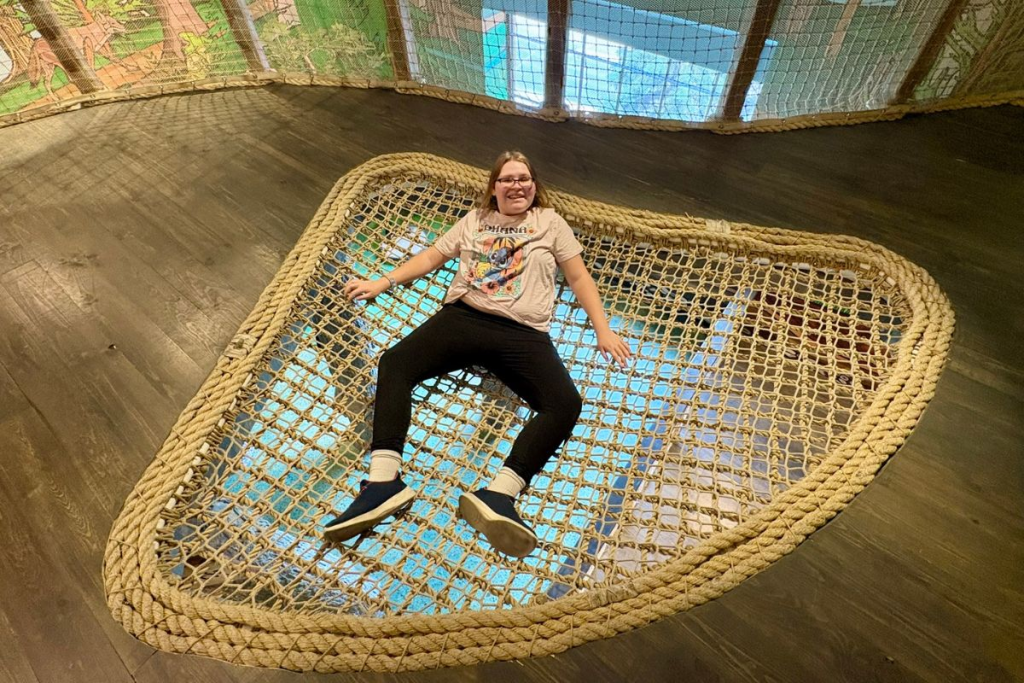
Branching Out is the first exhibit you see, located in the museum’s main open area. It’s a giant treehouse play area that’s pretty busy and active, and has a layout that makes it very hard to keep eyes on a child from the ground. The treehouse has three exits (a rock-climbing wall, a slide, and stairs), and they’re not in the same area, so close supervision is necessary. That said, it’s easily accessible for adults. I had no trouble climbing the rock wall up, going down the slide, or using the rope balance bridge.
One feature I really liked in this area was the small quiet zone just before the first “tree” on the left. It had a few tree stumps to sit on and a basket of books—perfect for a sensory break.
Discovery Lab is located to the left of Branching Out, this is a separate, enclosed room with one (wide) entrance. It’s quieter and calmer than the other exhibits, making it ideal for a break or less stimulating activity. When we were there, they had kinetic sand—great for children who seek that sensory input.
The Community Rooms are next, in the large open space of the museum. This section is divided into separate “buildings”, and most are set up in a way that makes supervision easier.
- The School Room – Fully enclosed with one exit. Great for rest time if it’s not crowded.
- The House – Also fully enclosed and easy to supervise, but very popular and can get crowded.
- The Restaurant – Two exits, both in the dining area, so if your child is in the kitchen section, it’s still manageable.
- Rescue Headquarters – More open with two entrances (one standard and one “firetruck” sized). Needs closer supervision.
- Wellness Centre – One of the best areas. Fully enclosed with one entrance. One side had a crash mat, blocks, and yoga mats/cards. The other looked like a dentist’s office—great for helping kids prepare for real appointments.
- The Market – Hardest one to supervise. Three large entrances and always busy.
Farm Works is next. This exhibit is spread out and divided into three sections:
- The first part is out in the open area, very busy and hard to supervise.
- The second part (“the Factory”) is in its own “building” with two large doors—still not ideal for supervision.
- The third section is upstairs and at the end of the hall, which made it easier, though it was another busy spot.
Unearthed is to the left of Farm Works in a separate room. The Dinosaur Dig Pit and Field Lab section are easy to supervise if it’s not packed. The Caves lead into the water play area, so are harder to monitor.
This area has two great autism-friendly activities. First, the dig pit—filled with small plastic beads—is a good sensory option if it’s not overcrowded (when we visited, it was packed and there wasn’t space for another child to join). Then there’s a much quieter spot in the Ice Cave area, which wasn’t busy at all. It has Magna-Tiles and a light table—great for a calmer sensory break.
Above and Beyond is upstairs in a mostly self-contained, but looped area (so two ways to exit). It’s busy, but there’s a nice rest spot in a separate small room, with a crash pad, books, and a STEAM activity on a kid sized table. The planetarium is also up there, and between shows it’s another great quiet spot to take a break. The show itself was relaxing too.
STREAM is downstairs past Farm Works, at the back end of the open space. There are two exits—one leading to the caves. Plus, there are those doors leading to the outdoor area I didn’t get to check. This is definitely a spot where close supervision is needed.
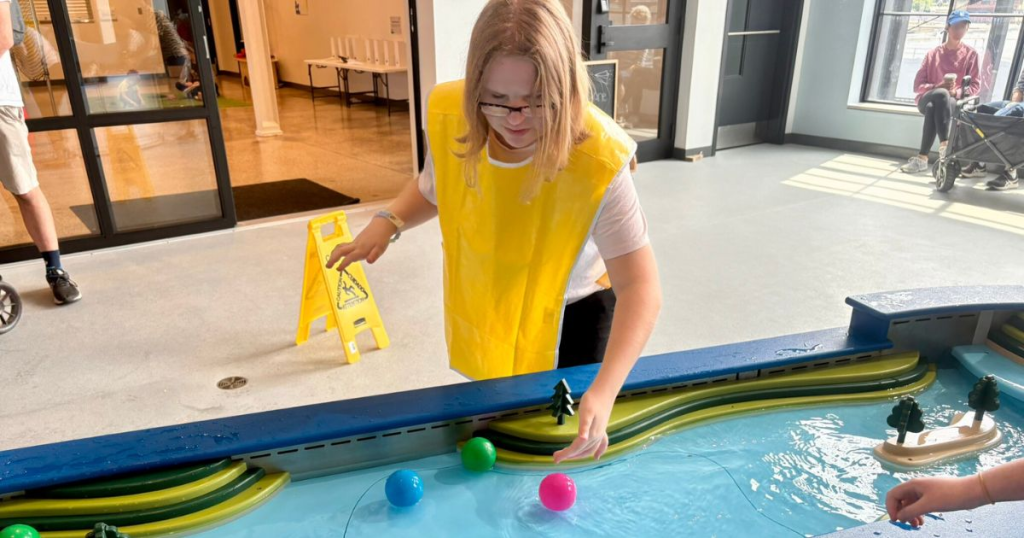
It’s also another great spot for sensory seekers, with the 70-foot-long water table. And they have lots of water smocks available to protect clothing. This is something I would’ve loved when Brie was younger. She couldn’t stand being wet, getting her clothes wet would trigger a meltdown and she’d try to take them off regardless of where we were. She’s thankfully gotten more tolerant now, but she still chose to wear a smock when I showed them to her.
The Annex is the last exhibit, off of STREAM, in a separate room but with multiple doors—including exits to that outdoor area. Another spot where close supervision is a must.
Sensory-Friendly Activities
Rating: 9/10
There are several exhibits that include a quiet, calm area with crash pads, books and/or relaxing activities. I loved seeing this—it’s a valuable addition that helps prevent overstimulation. There are also a few excellent sensory play spots, like the kinetic sand, the dig pit, and the water table, which are perfect for kids who need sensory input to help settle down.
Sensory bags
Rating: 9/10
The museum offers free sensory kits called Adventure Backpacks, another great accessible feature more places need to offer, that you can borrow from guest services. They also have weighted lap blankets. I didn’t bring Brie’s sensory kit, so we picked one up when we got our tickets just in case she needed anything. She didn’t end up using anything from it, but she liked checking out what was inside: headphones, a visual timer, sunglasses, a stress ball, and a fidget toy.
The museum’s website says the kits also include a social story and visual supports, but ours didn’t have those, so they may still be finalizing those resources. My only suggestion would be to include a pop-it and a few more fidget options for variety.
We didn’t need the items this time, but I remember how essential things like headphones were when Brie was younger—and how hard it was if I forgot to bring them. Eventually she got good at remembering on her own, but having a backup option at the museum is a huge help.
Sensory Friendly Evenings
Rating: 8/10
I love that sensory-friendly evenings are becoming more common at places like this. The museum hosts them twice a month from 5–8pm, with extremely limited attendance to help reduce noise and crowd levels. Admission is free for the entire family.
That said, spots book up fast. Every one listed on their website was already sold out. If you want to attend, I’d recommend emailing them to find out when new dates are posted so you can grab tickets quickly. I’d love to see the museum offer more of these, even if they had to charge regular admission, because the demand is there.
Since Brie is older and can handle more stimulation now, I wasn’t too concerned about visiting during regular hours. But because the museum is still new and getting lots of visitors, I emailed ahead to ask about the best times to come. They recommended afternoons to avoid school groups, so 1:30–2:30 p.m. would probably be a good time.
Other Spaces in the London Children’s Museums
Quiet Room
Rating: 8/10
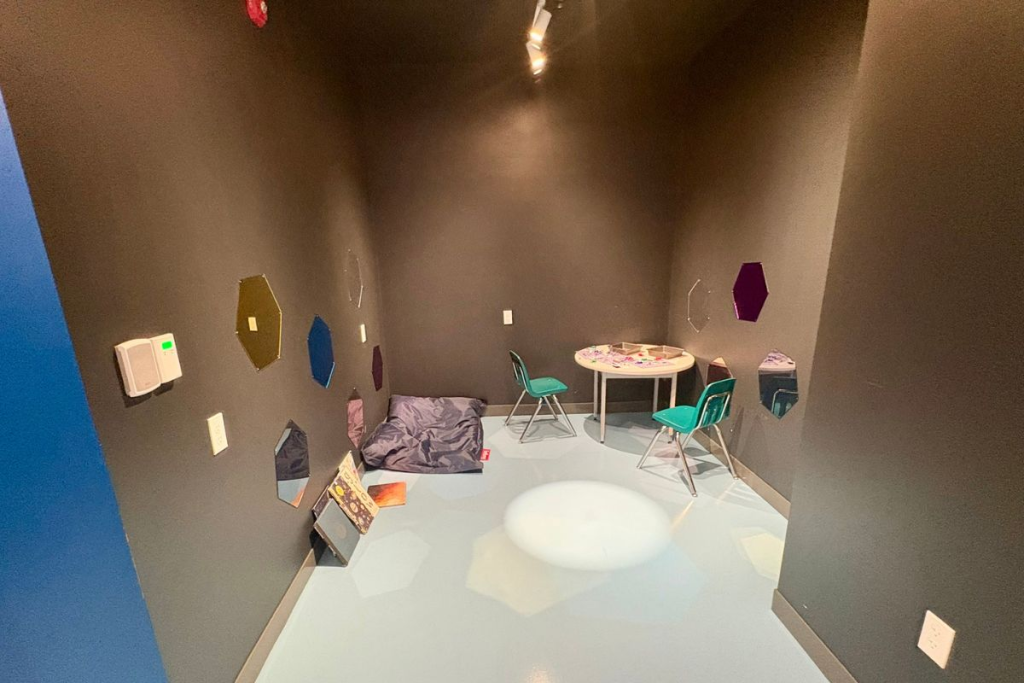
You don’t see “quiet rooms” in many public children’s places, but you should. Having a calm, private spot to bring an overwhelmed child is a huge accessibility feature—and one I hope more places start offering.
This one is fairly well done. It has a cozy couch (low to the ground for safety), a standard chair for adults, and there was enough space for us (two teens and an adult) to be in there comfortably. There’s a visual timer, some books, a couple hourglass timers, and a large fidget board—both my kids loved that. The couch is actually a play couch, so it can be used for light physical play if your child needs movement.
The only downside is noise. Even though it’s behind two closed doors, you can still hear the nearby water play area. It’s clear the museum picked the best location they could, it’s in the back corner, behind the baby care room, but without soundproofing, some noise is unavoidable. If your child wears headphones or likes calming music on a phone, that could help.
When we visited, Brie wasn’t overstimulated, we just went in for a preventative break, and the noise didn’t bother her. But for a child in full meltdown mode, it might not be quiet enough.
Eating Area
Rating: 10/10
Outside food is allowed! That alone makes this space accessible for families dealing with food allergies, intolerances, or just picky eaters. Plus, it saves money.
The museum does sell food through two vending machines, which had drinks, muffins, Lunchables, wraps, sandwiches and fruit. They also have in-and-out privileges, so you have a lot more options with the five restaurants right inside 100 Kellogg Lane, and more nearby.
Washrooms
Rating: 10/10
They nailed this! Accessible for everyone. There are three locations throughout the museum, making bathroom breaks quick and easy (especially with kids who wait until the last second). Even better? The universal/inclusive washroom setup. It allows caregivers to easily assist someone of the opposite gender. More places should be designing bathrooms like this.
Brie’s Experience
Brie’s favorite exhibit (no surprise) was STREAM. When we went to the Please Touch Museum in Philadelphia years ago, this was her favorite spot too. Her second favorite was the treehouse, also not surprising. She’s always loved playgrounds, and this new version is bigger and better than the one at the old museum.
The only thing she didn’t like was the noise.
Visiting at 17 is a much different experience than when she was 5. She didn’t ask for headphones at all and only needed one short, preventative break. I told her before we got there that the sensory room was an option, and she could ask to go anytime she needed.
She spent more time looking around than playing, which didn’t surprise me. She tried a few things, but her favorite part seemed to be just watching other kids. That’s something she’s always enjoyed—like when she used to stand at the bottom of the slide just to watch the other kids come down.
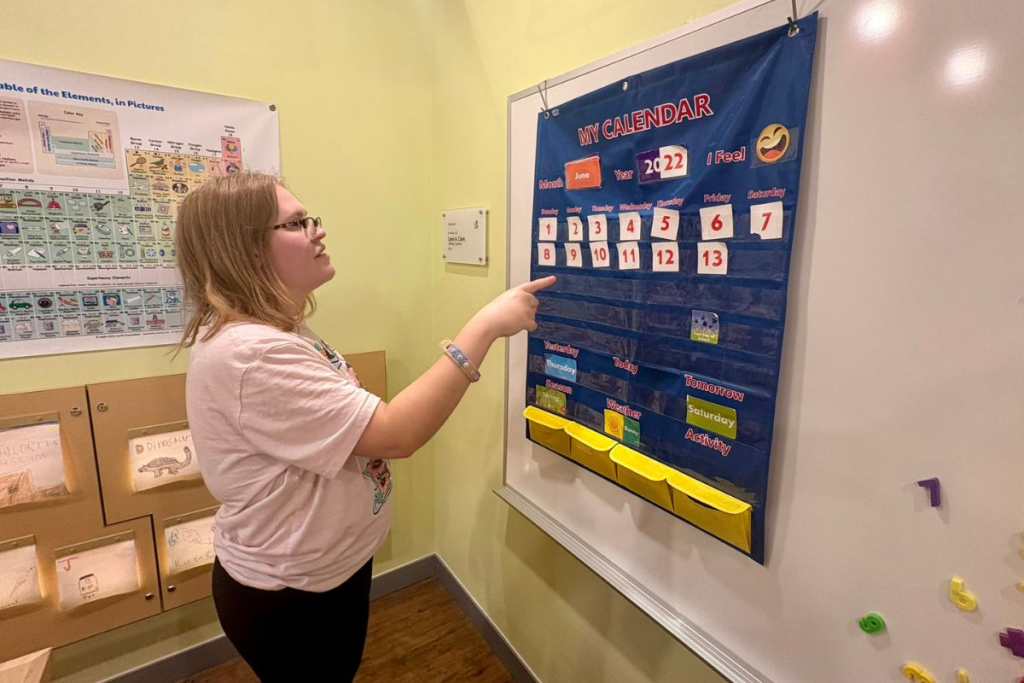
And then there was the cleaning. She may have found her dream job. In the school room, she updated the calendar and weather chart because it was wrong. In the restaurant, she sorted the pretend ice cream scoops back into their proper bins. Throughout the museum, if something was out of place, she quietly fixed it.
The new London Children’s Museum is a huge upgrade—cleaner, more modern, and a lot more accessible than the old space. It’s not a perfect fit for every autistic child or teen, but it offers more sensory-friendly features than most places we’ve visited.
Some exhibits are easier to supervise than others. Depending on the needs of your child (and if you’re managing multiple kids), having a second adult can make a big difference, especially in the more open areas.
Overall, I’d call our London Children’s Museum autism experience a success. We stayed longer than I expected, and I was impressed with the thought put into sensory spaces and accessibility. For a few hours of hands-on, creative play in a controlled setting, this is one of the better autism-friendly activities in London, Ontario.
If you’re looking for more autism-friendly travel in Ontario, including museum visits, day trips, and special needs activities for adults, follow us on Facebook and TikTok. We share our “Is it Autism Friendly” reviews and practical tips for families navigating Ontario sensory friendly travel —plus accessible options in other destinations across North America.
Want to share your experience at the London Children Museums new location or recommend other sensory-friendly attractions in Ontario? Join our new Autism on Vacation Facebook group, where families can share reviews and tips or ask others for advice when planning their trips.
More Autism Travel Planning Resources
London
- The London Children’s Museum Review
- Is Pumpkins After Dark Autism Friendly?
- Is the Big Bounce Autism Friendly?
Travel Tips
- Autism Travel Tips: A Parent’s Guide for Traveling with Autism
- Tips for Traveling with Autism: Road Trips
- Finding Autism Friendly Hotels
- Travel Sensory Kit for Autism
Ontario Destinations
- Niagara Falls Travel Guides and Reviews
- Ottawa Travel Guides and Reviews
- Toronto Travel Guides and Reviews
- London Travel Guides and Reviews